Program

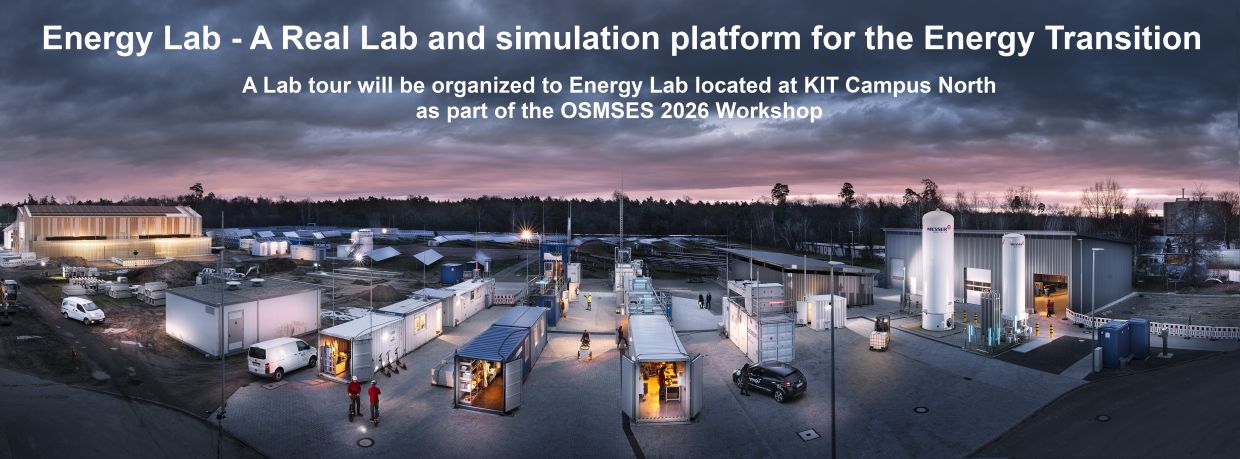
Lab tour Energy Lab

The program with the accepted papers and tutorials is available for download.


4th International workshop on
"Open Source Modelling and Simulation of Energy Systems"
OSMSES 2026
23-25 March 2026

Monday, 23 of March


11:30-13.00

Registration and Snack

13:00-13:15

Welcome by Veit Hagenmeyer (Building 11.30 – Senate Hall)

13:15-14:45

Tutorial Session 1 (in parallel)


  • Tutorial 1: Pietro Rando Mazzarino, "Integrating Reinforcement Learning into Distributed Co-Simulation Environments for Energy Systems" (Building 11.30 – Senate Hall)

    This tutorial introduces a HELICS-based software framework that integrates distributed co-simulation with Reinforcement Learning (RL) to enable realistic, multidomain experimentation across power systems, buildings, and thermal or gas networks. By embedding RL agents as native co-simulation components, the platform supports natural interaction with physics- and rule-based models, hybrid modelling strategies, and Gymnasium-compatible online or offline training. The session provides conceptual background, an overview of the architecture, and a live demonstration showing how to configure, train, and evaluate RL agents within complex energy system scenarios, concluding with open challenges and future research directions.
  • Tutorial 2: Martin Hofmann, "PYORPS: Automated Underground Cable Routing for Distribution Grid Planning" (Building 11.40 – Room 202)

    This tutorial introduces PYORPS (Python for Optimal Routes in Power Systems), an opensource tool that applies highresolution raster geodata and leastcost path methods to automate underground cable routing in distribution grids, capturing terraindependent construction costs and environmental constraints. The session covers the fundamentals of rasterbased cost modelling and searchspace optimisation and features two handson case studies: selecting an optimal point of common coupling for utilityscale PV plants and integrating PYORPS into automated grid expansion workflows. Participants learn how to configure datasets, tune routing parameters, and balance accuracy with computation time, using exclusively opensource data and tools.
  • Tutorial 3: Pimprenelle Parmentier and Mathieu Vallée, "Cairn Open, an open-source optimization tool for dimensioning and managing complex energy systems" (Building 11.40 – Room 231)

    Cairn is an open-source optimization tool (based on MILP solvers) used by researchers and engineers to optimize a wide range of energy systems, including electricity, hydrogen, and heat technologies. Some of the tool's key features include its ability to optimize environmental criteria, as well as its graphical user interface, which makes it easy to share and communicate studies. This tutorial is dedicated to learning how to use Cairn Open to carry out an optimization study and answer questions related to an energy system. The tutorial will combine theoretical concepts with hands-on practical work based on a demonstration case. In particular, the course will focus on modeling the case study, setting parameters, running the optimization, and retrieving and analyzing the results.

14:45-16:15

Tutorial Session 2 (in parallel)


  • Tutorial 4: Jianlei Liu, Richard Lutz, Jannik Sidler, Michael Maier, Thorsten Schlachter and Veit Hagenmeyer "Co-Simulation of Energy Systems using PROOF" (Building 11.30 – Senate Hall)

    Efficient automation of complex workflows and co-simulations is crucial for implementing and executing distributed multi-domain energy systems. The PROcess Orchestration Framework (PROOF) is an open-source co-simulation tool providing the foundation for streamlining automation of computational scientific workflows and co-simulations across multiple disciplines. Through its web-based graphical user interface (UI), PROOF enables researchers to integrate models, design scenarios, and execute simulations in the form of workflows. This tutorial will provide attendees with an overview of PROOF, along with practical experience in building and running co-simulations or workflows via the PROOF UI. Attendees will not only learn the fundamentals of PROOF but also gain hands-on experience using the PROOF UI to build their own co-simulation participants.
  • Tutorial 5: Julius Ellermann and Patrik Schönfeldt "MTRESS – Model Template for Renewable Energy Supply Systems" (Building 11.40 – Room 231)

    MTRESS (Model Template for Renewable Energy Supply Systems) is an open-source tool. Based on the community driven open source tool oemof.solph, MTRESS allows for easy and fast creation of energy systems and their optimization with the included, pre-build, technologies commonly used in energy systems. These technologies are for example Heat Pumps, Electrolysers and Storages (Battery, Heat or Gas). Additionally, Energy flows can be enriched with qualities (temperature levels and pressures), for more realistic models. Moreover, the underlying omeof.solph model remains accessible, allowing for detailed customization to the use case.


16:15-16:30

Coffee break

16:30-17:45

Paper Session 1 "Energy System Planning" (Chair: Wolfgang Süß, Building 11.30 – Senate Hall)


  • João Almeida, Zenaida Mourão, Adrian Galvez and Tiago Soares, "Decarbonisation of Seaports Using OSeMOSYS: A Case Study of the Port of Sines"
  • Felix Clemens Alexander Auer, Diego Alejandro Tejada-Arango and Sonja Wogrin, "Uncovering Hidden Biases in Hydropower: Why Detailed Inflow Data is Crucial for Energy System Optimization Models"
  • Daniel Jung, Saikrishna Vallabhaneni, Frank Schuldt and Karsten von Maydell, "A Seamless Workflow from Open-Source Planning Models to Industry-Standard Stability Simulations"
  • Yiwen Pan, Andrea Benigni and Thiemo Pesch, "Towards PowerMarketSim – A Tight and Compact Unit Commitment Formulation for Europe's 15-Minute Day-Ahead Electricity Market"
  • Adrian Carrillo-Galvez, Rui Rodrigues, João Almeida, Pedro Costa, Tiago Soares and Zenaida Mourão, "Simulation-Based Assessment of Decarbonization Alternatives in Container Terminals"

17:45

End of Day 1


Tuesday, 24 of March


08:45-09:00

Welcome Coffee

09:00-09:45

Keynote Session 1 (Chair: Veit Hagenmeyer, Building 11.30 – Senate Hall)


  • Massimo Moser (TransnetBW), "Long-term energy infrastructure planning with integrated, transparent energy system models"

    Energy system models are frequently used in various contexts to minimize the costs of pathways to climate neutrality. By taking all key energy sectors into account as part of an integrated approach, the tool aims to optimize capacity expansion (power plants, transmission lines, and storage) as well as hourly dispatch planning for various target years in each region under consideration. Due to these unique features, energy system models have the potential to contribute to improved and cost-efficient planning of European energy infrastructure. In this presentation, we present insights into PyPSA-TSO, a powerful energy system planning tool based on the open-source tool PyPSA.

09:45-10:30

Paper Session 2 "Co-Simulation & Interoperability 1" (Chair: Hüseyin K. Çakmak, Building 11.30 – Senate Hall)


  • Alexandra Bach, Jitpanu Maneeratpongsuk and Antonelle Monti, "VILLASnode API Gateway demonstrated for FMU and OpenDSS Co-Simulation of IEEE13bus System"
  • Sebastian Eichhorn, Darlene Dullius, Anurag Mohapatra and Reinaldo Tonkoski, "From Co-Simulation to Composition: A Data-Driven Transformer with OLTC for Scalable Open-Source Power System Modeling"
  • Erfan Tajalli-Ardekani, Haozhen Cheng, Alexander Kocher, Jovana Kovačević, Simon Waczowicz, Hüseyin K. Çakmak, Giovanni Delibra, Alessandro Corsini and Veit Hagenmeyer, "GIS-AWBEM: GIS-based Automated White-Box Building Energy Modeling"

10:30-10:45

Coffee Break

10:45-12:30

Paper Session 3 "Co-Simulation & Interoperability 2" (Chair: Alexander Kocher, Building 11.30 – Senate Hall)


  • Sara Ferrero, Daniele Salvatore Schiera, Francesco Demetrio Minuto and Andrea Lanzini, "Enhancing pandapipes for Dynamic Simulation of District Heating Networks"
  • Eike Schulte, Jan Sören Schwarz, Malte Stomberg, Sharaf Alsharif, Danila Valko and Jirapa Kamsamrong, "mosaiks are made of tesserae: GUI design for a co-simulation framework"
  • Fabio Chini, Davide Canali, Pietro Rando Mazzarino, Daniele Schiera, Luca Barbierato, Lorenzo Bottaccioli, Edoardo Patti and Alessandro Margara, "Benchmarking Co-Simulation Orchestration Engines for Integrated Energy Systems: A Comparative Study of Mosaik and HELICS"
  • Mohammadreza Taheri, Pietro Rando Mazzarino and Daniele Salvatore Schiera, "Towards a Semantic-driven Automation of Modelling and Co-Simulation of Energy Systems"
  • Trevor Hardy, Philip Top and Ryan Mast, "Co-Simulation Distributed Time Management in HELICS"
  • Philipp Schmurr, Nan Liu, Andreas Schmidt, Hüseyin K. Çakmak, Alexander Kocher, Kai Baumgarten and Veit Hagenmeyer, "Generating RSCAD FX Models for Real-Time EMT-Simulation using Component Graphs and PyAPI-RTS"
  • Corinna Seiwerth and Reinhard German, "A Standardized Data Schema for Co-Simulation of Open-Source Power Flow Simulators"

12:30-13:30

Lunch Break

13:30-14:15

Keynote Session 2 (Chair: Andrea Benigni, Building 11.30 – Senate Hall)


  • Martha Frysztacki (OET), "Open-Source Energy System Models for Real-World Grid Planning"

    Open-source energy system models are gaining traction in grid planning yet remain only partially embedded in real-world operational and decision-making processes. Key barriers include challenges in tool selection, limited transparency on model capabilities, constrained data availability (particularly for NGOs, think tanks, and the research community), and concerns around governance and security in regulated applications. Addressing these gaps requires improved comparability, reproducibility, and reliability in applied settings. Tools such as the Open Model Tracker and solver benchmarking platforms enable transparent evaluation of models and optimisation approaches. For system operators, version-controlled data and open development practices are critical to ensure auditability, traceability, and integration into established planning processes, while open data expands access and scrutiny. Embedding open models in high-impact planning processes can enhance transparency and stakeholder trust, but depends on robust governance frameworks, including quality assurance, security standards, and clear decision rights. Together, these elements support the credible adoption of open models in industry and policy contexts.


14:15-15:30

Paper Session 4 "Power System and Grids" (Chair: Edmund Widl, Building 11.30 – Senate Hall)


  • Rabia Eda Patoğlu and Mustafa Alparslan Zehir, "An Open-Source Analysis Methodology for Battery Supported Islanded Operation in Residential Distribution Networks"
  • Marc Hunkemöller, Dirk Witthaut, Lars Schewe, Joost van Dijk, Mikhail Farber and Nico Westerbeck, "A GPU-based Newton--Raphson Algorithm for Power Flow under Topology Changes"
  • Ramon Zambetti, Marco Rossi and Giacomo Viganò, "OptiFlex.py – An open-source tool for electricity distribution planning with local flexibility"
  • Arsen Askar, Andreas Abart and Gerald Steinmaurer, "Open Distribution System Model"
  • Eric Lupascu, Xiao Li and Benjamin Schäfer, "Predicting Power grid frequency dynamics with invertible Koopman-based architectures"

15:30-15:45

Coffee Break

15:45-17:30

Paper Session 5 "Software, High-Performance Computing, and Other Applications 1" (Chair: Thiemo Pesch, Building 11.30 – Senate Hall)


  • Isabella Pizzuti and Giovanni Delibra, "pyRES: An Open-Source Python Package for Renewable Energy Community Design"
  • Kai Heussen, Jawad Kazmi, Narges Mehran, Artjoms Obushevs, Terence O'Donnell and Thomas Strasser, "Towards Reproducible Test Annotation for Cyber-Physical Energy Systems using Ontology-driven Dataspaces"
  • Henrik Wagner, Carsten Wegkamp, Constantin von Lützow, Marcel Lüdecke, Michel Meinert, Eike Niehs, Finnja Oestereich, Julien Essers, Lukas Ebbert and Bernd Engel, ""Extending eELib: Enhancing the Open-Source Model Library for Prosumer Power Systems and Energy Management Strategies"
  • Georgii Tishenin, Armin Teskeredzic and Antonello Monti, "Evaluating Time Step Effects in Shifted-Frequency Analysis for Converter-Dominated Power Systems"
  • Xuanhao Mu, Jianlei Liu, Gökhan Demirel, Thorsten Schlachter and Veit Hagenmeyer, "The Model-Build-Manifest: A Dependency Injection pattern for Structural Coupling in Sector-Coupled Energy Systems"
  • Florian Strebl, Catalin Gavriluta and Qianwen Xu, "From Image Generation to Power Systems – Learning the Representation of System Transients"
  • Blerant Ramadani and Vangel Fustic, "Physics-Informed Digital Twin for Pre-Deployment Validation of LSTM-Based Wind Power Forecasting Models"

17:45-19:00

Event 1: "Historische Führung KIT-CS"

19:00-21:30

Conference Dinner

21:30

End of Day 2


Wednesday, 25 of March


08:45-09:00

Welcome Coffee

09:00-10:30

Paper Session 6 "Software, High-Performance Computing, and Other Applications 2" (Chair: Thomas Strasser, Building 11.30 – Senate Hall)


  • Mahamat Habib Bechir, Filipe Tadeu Oliveira and Hermano Bernardo, "Temporal Resolution Matters: Assessing Its Impact on Variable Renewable Integration in Open-Source Long-Term Energy Planning Models"
  • Edmund Widl, Marc Dünser and Jort Groen, "A Framework for Digital Twin Runtime and Lifecycle Management"
  • Seyede Zahra Tajalli, Kai Heussen, Sridevi Krishnamurthi, Marcos Blanco, Jorge Na'Jera, A' Ngel Herna'Ndez, Gabriella Ferruzzi and Raffaele Liberatore, "Toward Reproducible and Automated Benchmarking on the Case of Renewable Energy Communities"
  • Jianlei Liu, Xuanhao Mu, Jannik Sidler, Richard Lutz, Jakob Geiges, Michael Maier, Thorsten Schlachter and Veit Hagenmeyer, "Tackling Heterogeneity with Containerized Wrappers and Synchronization Methods for Multi-Domain Energy Systems"
  • Yifei Lu, Junjie Zhang, Marcel Zimmer, Thiemo Pesch and Andrea Benigni, "Benchmark Test Grids for Coupled Power and Gas Systems Studies"
  • Antonio De Padova, Daniele Salvatore Schiera, Francesco Demetrio Minuto, Claudio Carbone, Alessandro Agostini and Andrea Lanzini, "Energy Transition Scenarios for Sardinia Island: Exploring Alternative Options for Decarbonization"

10:30-10:45

Coffee Break

11:00-11:30

Bus-ride to KIT-Campus North

11:30-13:00

Event 2 "Energy Lab Tour KIT-Campus North"

13:00-14:00

Lunch Casino KIT-Campus North

14:00-14:30

Bus ride to Karlsruhe train station and then to KIT-Campus South

14:30

End of Workshop